What’s the Difference Between Basement Waterproofing and Interior Drainage?
If you’ve started looking into basement water problems, you’ve probably run into both terms already. One contractor mentions waterproofing. Another talks about drain tile. A third says you need a sump pump. It can start to feel like everyone is describing something different, and it’s not always clear whether these are competing solutions or parts of the same one. So, basement waterproofing vs. interior drainage: which is actually right for your home?
They’re not competing. Waterproofing and drainage address different parts of the same problem, and in most cases a basement that stays reliably dry needs both working together. Understanding what each one actually does makes it a lot easier to evaluate what your basement needs and why.
What Basement Waterproofing Actually Does
Waterproofing is the barrier side of the equation. Its job is to address water at the point where it enters or threatens to enter the basement. Depending on what’s happening in a specific basement, that can take a few different forms.
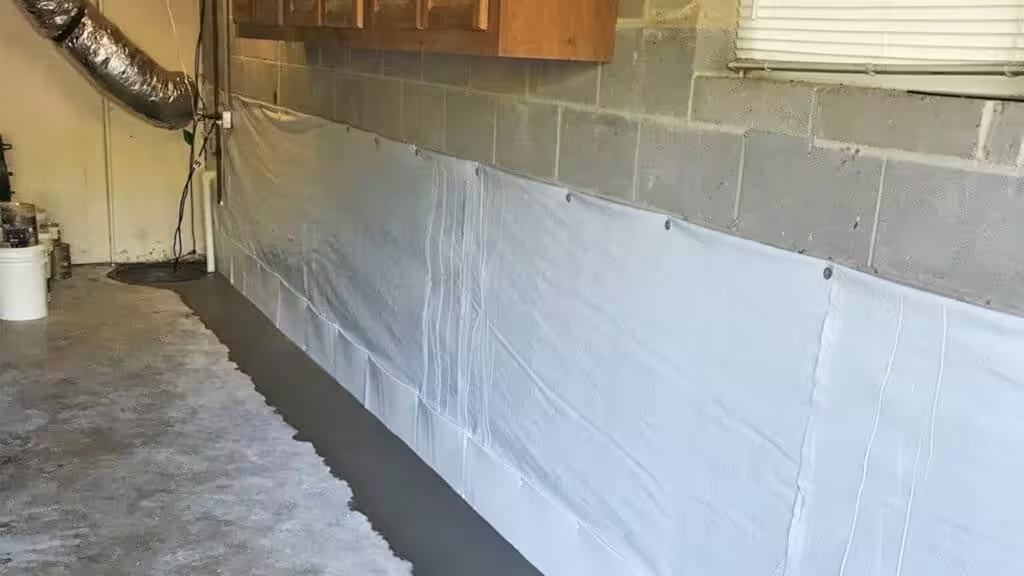
A wall membrane is a physical barrier applied to the interior face of the foundation wall. It blocks moisture that’s seeping through the concrete or block and directs it downward rather than letting it push through into the living space. An epoxy wall coating serves a similar purpose on poured concrete walls, sealing the surface against minor seepage. Crack repair addresses specific entry points directly, filling and sealing cracks in the wall or floor before water can use them as a path inside.
What all of these approaches have in common is that they deal with the wall itself. They’re not moving water anywhere. They’re stopping it, redirecting it, or sealing the surface it’s trying to come through. That’s an important distinction, because it means waterproofing alone can only do so much. If water is under enough pressure, or if it finds a path that isn’t sealed, it still needs somewhere to go. That’s where drainage comes in.
What an Interior Drainage System Does
Where waterproofing deals with the walls, interior drainage deals with the water itself. A drain tile system is installed at the base of the foundation wall, beneath the basement floor. It runs along the perimeter of the space and collects water that’s moving through or along the foundation, then channels it into a sump basin. From there, a sump pump moves it out of the house entirely.
The drain tile is a perforated pipe bedded in gravel. Water that seeps in at the wall-floor joint, migrates through the base of the wall, or builds up beneath the floor finds the pipe before it finds your floor. It’s not stopping the water from entering so much as intercepting it before it becomes a problem and giving it a controlled exit route.
The sump pump is what completes that route. Without a functioning pump at the end of the system, water would simply accumulate in the basin and eventually back up. A battery backup pump matters here too, because the storms that push the most water into a basement are often the same ones that knock out the power. A drainage system that goes offline during a heavy rain event isn’t doing its job when it’s needed most.
Interior drainage is a management system. It doesn’t prevent water from reaching the foundation, but it makes sure that water never gets the chance to sit on your floor.
Why Basement Waterproofing and Interior Drainage Work Better Together
Waterproofing and drainage are often talked about as separate services, and technically they are. But in practice, a basement that relies on only one of them has a gap in its protection. Here’s what that looks like in each direction.
When waterproofing is installed without drainage:
- The wall membrane redirects water seeping through the wall, sending it downward toward the floor
- With no drain tile at the base of the wall, that water has nowhere to go
- It pools at the wall-floor joint, sits against the foundation, and eventually finds another way in
- The membrane did its job, but the system as a whole didn’t
When drainage is installed without waterproofing:
- The drain tile collects and removes water effectively
- But the walls themselves are still unprotected
- Moisture continues to push through the concrete, efflorescence builds up, and the wall surface deteriorates over time
- The drainage is working, but the basement isn’t truly dry because the entry points are still open
When waterproofing and drainage are installed together, each one supports the other. The membrane handles the wall surface and directs water toward the drain. The drain tile collects it and moves it to the sump. The pump removes it from the home. When all three components are functioning, the basement stays dry even under significant hydrostatic pressure.
What Goes Wrong When One Piece Is Missing
Homeowners sometimes end up with an incomplete system not because anyone made a bad decision, but because water problems tend to reveal themselves gradually. A crack gets repaired. A sump pump gets installed. Each fix addressed a real symptom at the time. But patching individual problems without looking at the full picture can leave a basement that’s perpetually one heavy rain away from an issue.
A basement with drainage but no wall protection:
- The floor stays relatively dry, but the walls absorb moisture season after season
- That ongoing moisture damages insulation and promotes mold growth on framing and drywall
- The wall surface gradually weakens, but the damage accumulates quietly rather than announcing itself
- By the time something visible forces the issue, the deterioration is often already significant
A basement with wall protection but inadequate drainage:
- Water that can’t get through the walls still exerts pressure against them during heavy rain
- That pressure doesn’t dissipate on its own; it looks for the next weakest point
- Floor cracks, pipe penetrations, and uncoated wall sections all become vulnerable
- Waterproofing without drainage asks the barrier to hold indefinitely against pressure it was never designed to handle alone
The most reliable basement systems aren’t built around a single product or a single fix. They’re built around an honest assessment of where water is coming from, how it’s moving, and what combination of solutions gives it nowhere to go.
Getting the Right Assessment for Your Basement
So, what’s the the verdict with basement waterproofing vs interior drainage? The challenge with basement water problems is that the same symptom, a wet floor, a damp wall, a musty smell, can have more than one cause. A basement that needs a wall membrane isn’t the same as one that needs drain tile replaced, and a basement that needs both is different from one that just needs a sump pump upgrade. Treating the wrong problem, or treating only part of the right one, tends to produce results that don’t last.
That’s why an inspection matters before any work gets done. Accurate Basement Repair has been helping Milwaukee-area homeowners diagnose and fix basement water problems since 2008. Their inspections are free, come with no sales pressure, and are designed to give you a clear picture of what’s actually happening in your basement before anyone recommends a solution. With over 1,073 five-star reviews and a Guaranteed Solutions for Life warranty backing every repair, the goal is a fix that holds, not one that needs to be revisited every few years.
Schedule a free estimate and find out exactly what your basement needs.