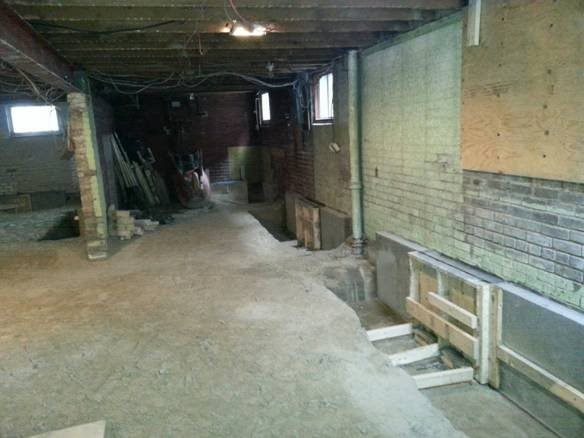
The foundation of your house needs to be secure; it’s the basis for every other component of your home. Usually, you would be considering foundation repair when there are visible signs that your basement is damaged. However, if you are going to undertake renovations that involve adding a story (or more) to your home, you should also consult with a professional about foundation repair. One of the professionals at Accurate Basement can determine whether your house needs underpinning.
Causes
When the subsoil expands and contracts and draws away from the foundation, it can create subsidence. For the Milwaukee area and its surroundings, the soil is primarily clay, and foundations built on expansive clay can be particularly prone to subsidence. Sometimes, a house is built on improperly compacted fill soils, or the drainage solutions malfunction. Another cause of subsidence is extreme seasonal changes. We live in Wisconsin, so that definitely applies.
Symptoms
The most obvious signs to look out for are cracks in the walls. If there are cracks wider than ¼ inch, that’s a danger signal. Diagonal cracks are another indication that you may need foundation repair. Cracks in your concrete floor are another sign that something may be wrong. And of course, heaving or buckling of walls or floor should prompt an immediate call to the experts at Accurate Basement.
Cure
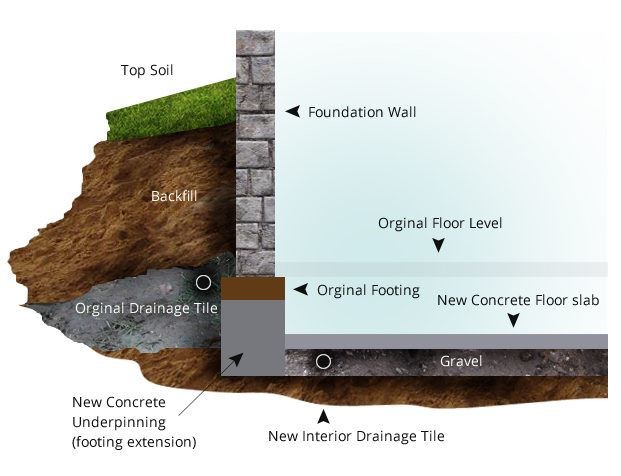
In some cases, repairing faulty drains or removing trees that are damaging the ground can be enough to correct the problem. More typically, basement underpinning is necessary. Underpinning strengthens the existing foundations by excavating below the foundation depth and repairing either the entire foundation or the faulty sections of the foundation.
There are various forms of underpinning. The main ones involve either digging out sections below the foundations and filling them with concrete or driving piles into the ground. Whichever is used, it’s a highly specialist procedure, and you need to have an expert undertake the work. At Accurate Basement, we have been doing foundation repair successfully for years.
The most common method of underpinning is the mass pour method. This process requires excavating sections in sequence to a pre-established depth below the footing and placing concrete in each pit. Then, this process is repeated until the entire affected area has been underpinned.
Underpinning with screw piles and brackets is typically used where mass pour underpinning is not possible. Some buildings might require excavating to extraordinary depths or some other reason may make it unfeasible. Screw piles can be installed in foundations with particular qualities. They are ideal when used with underpinning support brackets. The structure can then be lifted back to a level position and the weight of the foundation transferred to the bracket system.
Underpinning with pile and beams is another underpinning method. With this system, a mini-pile must be installed on either side of the affected wall. After the piles have been installed, then brickwork is removed below the wall and a reinforced concrete needle beam is used to connect the piles and support the wall.
If you have concerns about your home’s foundation, contact the professionals at Accurate Basement. We can help you determine whether you need foundation repair, and which kind of underpinning would be best for your particular home.
Contact the professionals at Accurate Basement Repair today! (414) 744 6900
Underpinning FAQs
How much does it cost to underpin a house?
The cost of underpinning a house can vary significantly depending on the extent of the foundation problem, the size of the affected area, soil conditions, the underpinning method used, and how accessible the foundation is. Smaller projects may require support in only a limited area, while more extensive settlement can require multiple piers or larger-scale structural work. Because every foundation is different, a professional inspection is the best way to determine the scope of work and provide an accurate estimate.
How long does it take to underpin a house?
The time required to underpin a house depends on the size of the property, how much of the foundation needs support, the underpinning method, soil conditions, and site access. A localized repair may take considerably less time than underpinning multiple sections of a foundation. More extensive projects can take several weeks to complete. A foundation professional can provide a more accurate timeline after evaluating the property and determining the appropriate repair method.
Are there alternatives to underpinning a foundation?
Underpinning is not always the only possible solution to a foundation problem. Depending on the cause, repairing drainage problems, addressing leaking pipes, removing problematic trees, stabilizing soil, or using another foundation repair method may be appropriate. The right solution depends on why the foundation is moving and how severe the problem is. A professional foundation inspection can help determine whether underpinning is necessary or whether a less extensive repair could address the underlying cause.
Is underpinning a permanent solution?
Properly designed and installed underpinning is intended to provide long-term stabilization for a foundation. However, the durability of the repair also depends on addressing the underlying cause of the foundation movement. For example, ongoing drainage problems, soil movement, or other conditions that affect the foundation can create new issues if they are not corrected. A qualified foundation professional can evaluate both the foundation and the conditions around it to develop a repair strategy designed for long-term stability.